Qatar Hub
01
Read Next
Practical AI adoption in Qatar's commercial sector: enterprise automation, inventory forecasting, bilingual Arabic customer models, and cloud infrastructure yielding measurable operational ROI. Grounded in GCC operating realities.
Prioritise applied operational workflows (demand forecasting, dynamic pricing, support deflection) over generic exploratory AI sandboxes.
Mandate sovereign cloud data residency compliance under Qatar NCSA guidelines for all enterprise customer data.
Establish rigorous baseline labor and throughput benchmarks before deploying automation to verify genuine unit cost reduction.
Across Qatar's corporate and commercial landscape, enterprise AI discussions are frequent, yet production rollouts that deliver measurable bottom-line EBITDA contribution remain scarce. Large-scale models and generic generative tools are often deployed as experimental vanity projects without clear alignment to operational bottlenecks.
The core operating question for Qatar business leaders is: How do commercial organizations deploy artificial intelligence into foundational workflows—such as supply chain optimisation, catalogue enrichment, and customer engagement—in ways that demonstrably compress unit costs and accelerate working capital velocity?
Without strict attribution to labor reduction, error shrinkage, or revenue uplift, corporate AI initiatives quickly deteriorate into open-ended software licensing drains.
Deploying applied AI in Doha requires balancing infrastructure compute costs against operational labor displacement. Every deployed automation model must clear model hosting costs, prompt token fees, cloud data transfer, and human oversight audits before demonstrating positive ROI.
| Cost Component | Operational Target | Risk Threshold |
|---|---|---|
| Token & Cloud Compute Spend | < 3% of Workflow Revenue | > 6% indicates unoptimized model selection |
| Implementation & Integration CapEx | < 18 Month Full Payback | > 24 Month amortisation risks tech obsolescence |
| First-Contact Resolution (FCR) Deflection | > 65% Automated Handling | < 45% requires human fallback overhaul |
| Catalogue Enrichment & Visual QA | < QAR 0.40 per SKU Enriched | > QAR 1.20 manual workflow cost parity |
| Demand Forecast Accuracy (MAPE) | < 8% Deviation on Top SKUs | > 15% causes inventory stockout or dead capital |
Source: Operator model — harisaslam.qa — Targets are operating benchmarks, not guaranteed results.
Successful AI execution requires embedding automated inference directly into existing ERP, warehouse, and POS systems without disrupting daily trading rhythm or introducing security vulnerabilities.
Sovereign Cloud Compliance: Hosting on Qatar-based hyperscaler regions (Google Cloud Doha / Microsoft Azure Qatar) adhering to National Cyber Security Agency (NCSA) data protection frameworks.
Bilingual Dialect Tuning: Custom fine-tuning and retrieval-augmented generation (RAG) handling Gulf Arabic idioms and English customer service interchangeably.
Human-in-the-Loop Safeguards: Real-time confidence scoring gating high-value commercial actions (refunds, pricing shifts, supplier purchase orders) through human verification.
Prior to enterprise-wide rollout, operators must validate automation through three distinct stress gates. First, verify model latency and inference reliability under peak transaction loads with sub-3 second end-to-end response times.
Second, run shadow testing against historical enterprise decisions to measure false positive and hallucination rates in pricing or catalogue taxonomies.
Third, establish that automated workflows produce at least a 25% net efficiency gain in processing time or direct labor savings over a consecutive 60-day operational cycle before retiring legacy systems.
Qatar's technology agenda is anchored by the Ministry of Communications and Information Technology (MCIT) and the TASMU Smart Qatar program, alongside local cloud regions from Google Cloud Doha and Microsoft Cloud. Enterprise AI adoption in Qatar benefits from nationwide 5G infrastructure, research grants from QRDI Council, and regulatory clarity from Qatar Central Bank (QCB), providing an exceptionally stable environment for high-impact commercial automation.
HA
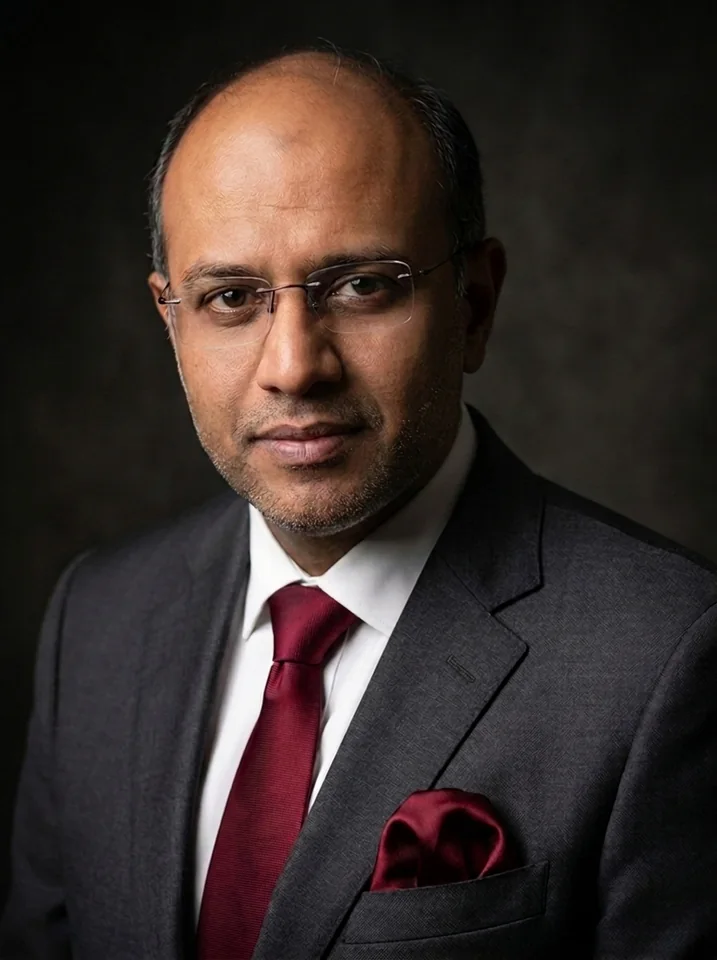
17+ years building, launching, and operating digital commerce, marketplaces, and retail turnarounds across Qatar, Oman, and the GCC. Focused on unit economics, daily execution, and cash-generating growth.